Invite participants
with a clear purpose
Write down what participation means before collecting information.
Connect customer observations in a thoughtful shared library.
Keep the context, follow the evidence, and learn together.
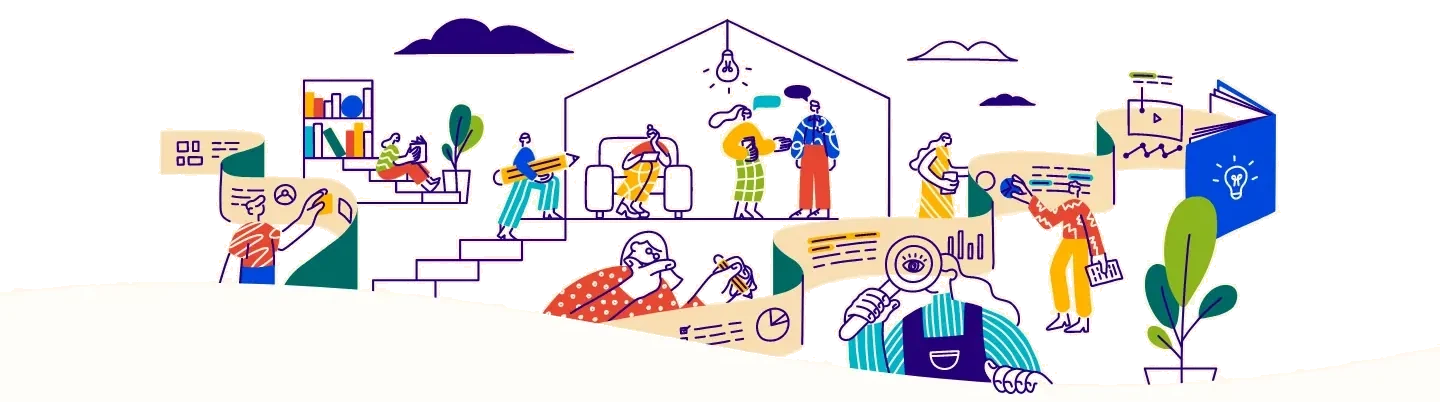

Keep the little details close. Bring notes, labels and observations into one shared research practice. Follow the context behind an insight, and give your team a clearer starting point for the next conversation.
Explore the listening workflow →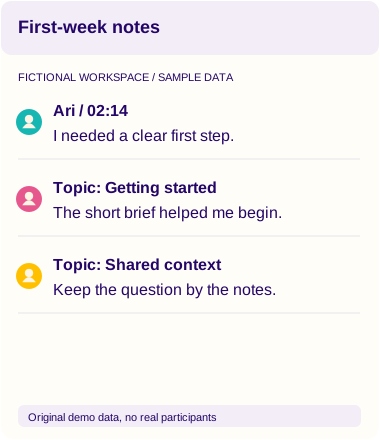
Collect a note, a question, or a short reflection. Give it enough context that someone else can understand why it matters.
Explore the workflow →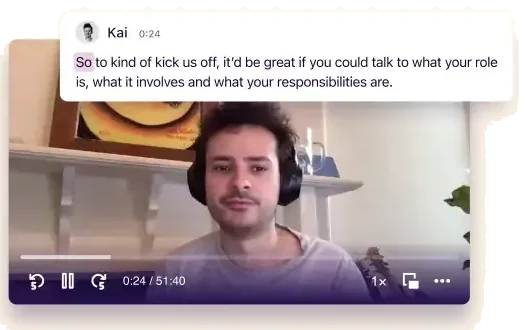
A small set of clear labels makes it easier to compare what people need. Keep the observation and your interpretation side by side.
Explore the workflow →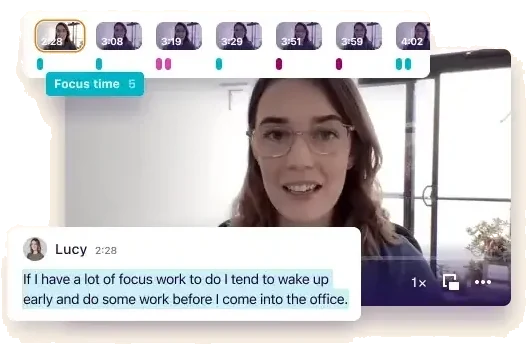
Every summary needs a starting point. Connect your thinking to the notes that inspired it, so your team can explore another reading.
Explore the workflow →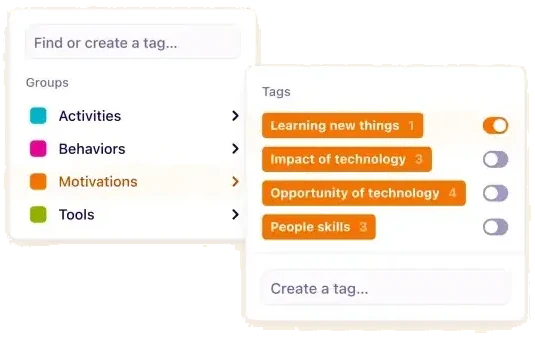

Give each project a home. Keep research notes and project reflections in one searchable collection. Return to earlier questions, see what has changed, and make room for the next discovery.
Explore the research library →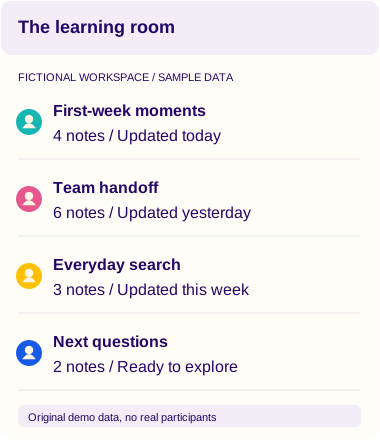
A useful repository carries the question, the observation and the uncertainty. This demo library gives each piece a clear place.
Explore the sample plans →
Notes, discussion and project summaries share a simple visual structure. Your team can bring its own research practice.
Explore the workflow →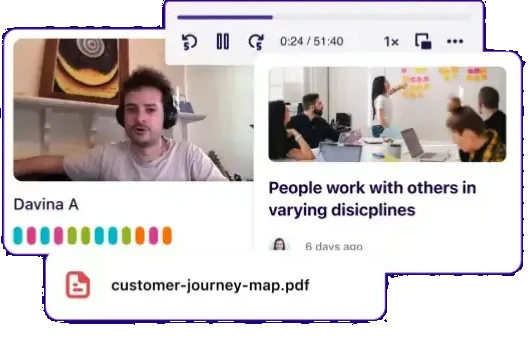

An illustrative participant view helps connect studies with context. The archived product preview illustrates a table layout, with sample workflow notes below.
Explore participant planning →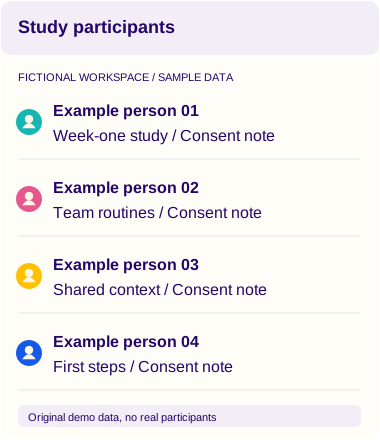
Write down what participation means before collecting information.
Keep the study question close to the observations.
Design your real workflow around consent and retention.
Use clear language for the people working with you.

Share an observation before it becomes an assumption. These are fictional product ideas, not delivered enterprise features.
Bring product, design and research into the same discussion.
A useful brief says what you hope to learn and why.
Show the difference between a quote and your conclusion.
End the discussion with a small, testable next step.
Real research needs appropriate privacy practices. This static template makes no security or compliance claims.
Explore our care principles →Before a real launch, define consent, access and retention with your organization. This demo contains no real participant records.
Explore the workflow →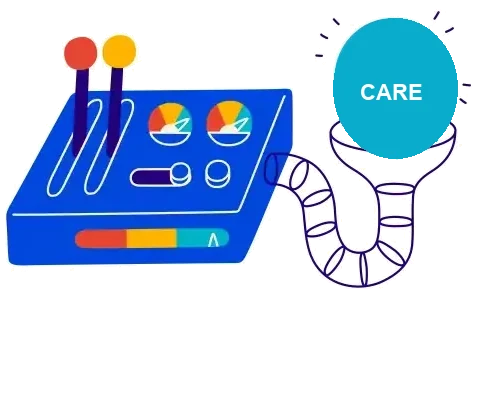
Choose the right audience for each piece of research. The local template has no accounts, storage service or permission system.
Explore the workflow →
Build a real research practice around purpose, consent and appropriate access. This fictional template holds no participant data and claims no certifications.
Explore the care principles →
A fictional discussion room illustrates how teammates could reflect on their week. No chat service is connected.
Explore the learning journal →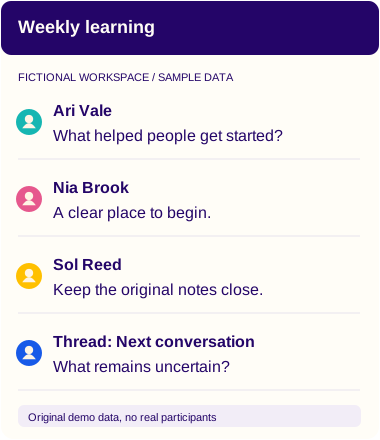
Original sample field guides, illustrated with reference imagery.
 practice / Sample article
A smaller question can change the shape of a study. This sample field guide explores how a fictional creative team might turn a broad ambition into a useful research prompt.
Read sample guide → teams / Sample article
Good learning travels with its context. Explore an original sample guide to keeping the question, the observation and the uncertainty together as your team works toward its next decision.
Read sample guide → practice / Sample article
Leave space for another interpretation. A fictional team explores how to compare observations, follow an evidence trail and keep useful questions open for the next conversation.
Read sample guide →
A fictional workspace for learning together. Try the local demo flow.