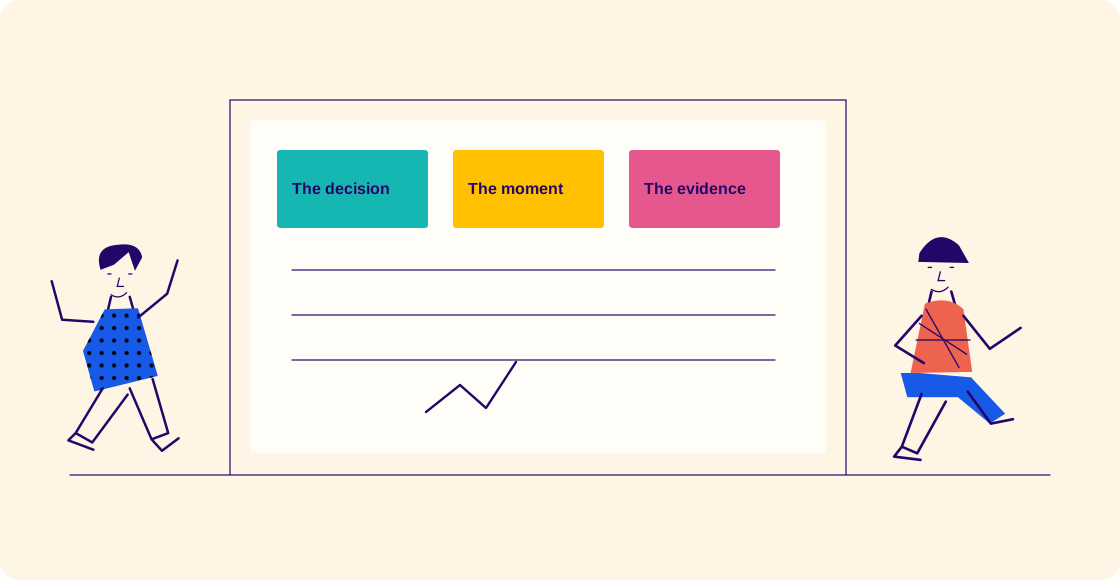
A team wants to understand why a new workspace feels confusing. Someone suggests asking people what they think of the whole product. It sounds reasonable, but it gives the study too many jobs. A broad question can collect plenty of opinions while leaving the next decision unclear.
A smaller question gives a conversation a center. It helps you choose who to speak with, which moments to explore, and what kind of evidence would actually change your next step.
1. Begin with the decision.
Before writing an interview guide, write down the decision your team is facing. In our fictional example, the team needs to choose what a new member sees on the first visit. That is more specific than deciding whether the whole product is easy to use.
Try completing this sentence: “After this study, we need to decide…” If the answer contains several independent decisions, choose one for the first round. The others can become a later study.
A useful question creates room for surprise while keeping the next decision in view.
2. Name the moment.
“How do people organize their work?” could take you almost anywhere. “What happens when a new teammate opens a shared project for the first time?” gives you a moment to explore. You can ask about the expectations, the first action, and the places where someone hesitated.
Our fictional team rewrites its question: “What helps a new member choose a useful first step?” The wording leaves room for different answers. It does not assume that a checklist, a tour, or a particular feature is the solution.
3. Separate observation from interpretation.
Suppose a participant opens three menus and then returns to the project overview. The observation is the sequence of actions. “The navigation is broken” is an interpretation. Keep both, but label them differently. Another explanation might be that the participant was exploring before committing to an action.
Write a short note in three parts: what happened, what you think it might mean, and what you still need to understand. This structure keeps a confident story from hiding an uncertain conclusion.
4. Look for differences as well as patterns.
Repeated behavior can be useful, but a small study does not automatically describe every user. One participant may know the vocabulary already. Another may be joining a project that someone else created. Those differences can explain why the same screen feels obvious to one person and puzzling to another.
Compare the context before combining observations into a theme. A clear pattern says who experienced something, in which situation, and what evidence supports that reading. Avoid turning a handful of conversations into an unsupported percentage.
5. End with a smaller next step.
The fictional team learns that new members look for a sign of what their colleague expects them to do. Instead of redesigning the whole workspace, the team sketches a short project introduction that names the purpose and one suggested starting point.
The next study can ask whether that introduction helps people choose a first action. Learning continues through a sequence of small decisions, each connected to evidence.
A brief you can reuse.
- Decision: What will this study help us choose?
- Moment: Which specific situation should we explore?
- People: Whose experience is relevant to that situation?
- Evidence: What would support or challenge our current thinking?
- Next step: What is the smallest useful thing we can try?
Keep the brief close to your notes. When the conversation becomes broad, return to the decision. When an unexpected detail matters, record it and decide whether it belongs in this study or deserves its own question.